 Vermont Republic Second Vermont Republic

When it’s the first time you’re looking at betting odds, you might get confused. Numbers like 1.60, 4,80, +150, or -200. All those numbers are doing two basic things. They show the possible return from a bet and give you an idea of how the market sees each result.
Start With What the Numbers Mean
Higher odds mean the team is less likely to win. Lower odds mean the team has a better chance of winning. This is the main thing to remember when reading odds. Football doesn’t always follow expectations, and the favorite can still lose, but the idea of the odds is as simple as that. Expectations don’t always meet the needs.
Fractional Odds Are Another Option
In the UK, odds can look like 2/1 or 5/2. For example, at 2/1, a $10 bet can win you $20 in profit. Now look at 1/2. Here, you need to bet $2 to make $1 profit. Different format, same basic idea.
Odds Can Tell You About Probability
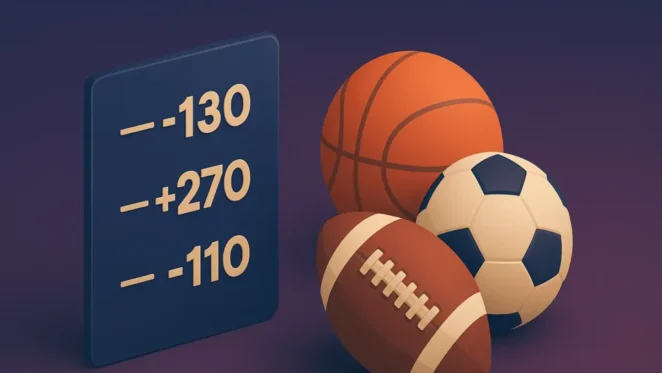
There is more information inside decimal odds than just the possible return. You can also use the odds to see the chance of something happening. Just divide 1 by the odds and multiply by 100.
For example:
- Odds of 2.00 = 50%
- Odds of 4.00 = 25%
A Few Numbers to Remember
You don’t need to calculate everything in your head, but these examples can help:
- 1.25 = 80%
- 1.50 = about 67%
- 2.00 = 50%
- 2.50 = 40%
- 4.00 = 25%
- 5.00 = 20%
These percentages aren’t guarantees. They are simply another way of reading what the odds suggest.
Odds Don’t Stay in One Place
Check a match on Monday and one team is 2.20. Come back on Friday, and it may be 1.85. The match hasn’t even started, so why did the price change at PlayBaze login live casino? Something may have happened during the week. Perhaps an important player returned from injury. Maybe the weather forecast changed. New information about the expected lineup could also affect the market. Betting activity can play a part as well.
Injuries Can Move the Numbers Quickly
Imagine an NFL team losing its main quarterback right before a game. That is important news. The team’s chances may now look worse, so the odds can change. Numbers for the opposing team could move as well. Football, basketball, tennis, and other sports have similar situations. The importance of one missing player depends on the sport and the team.
Favourite and Underdog Are Simple Terms
You’ll hear these words all the time. The favourite is the side expected to have the better chance of winning. The underdog has the lower expected chance. Imagine two tennis players. One has decimal odds of 1.40. One player has odds of 1.40 and the other has 3.20. The first player is the favourite, and the other is the underdog. Why does the underdog offer a bigger possible return?
Bigger Odds Don’t Mean Better Odds
A number like 12.00 immediately stands out. Put $10 on it and the possible return is much larger than a $10 bet at 1.50. There is a reason for that. The 12.00 outcome is considered much less likely to happen. A large possible return doesn’t automatically make something a good choice.
Don’t Forget the Draw
Football beginners sometimes focus only on the two teams. There is a third result. The draw. That makes football different from many sports where one side must eventually win. A match between two evenly matched teams may have fairly close prices for all three outcomes. When one team is a huge favourite, the numbers can be much further apart. Ignoring the draw means ignoring an important part of the market.